The Habsburgs’ “Other Court”: Women’s History of Madrid Through Las Descalzas and La Encarnación
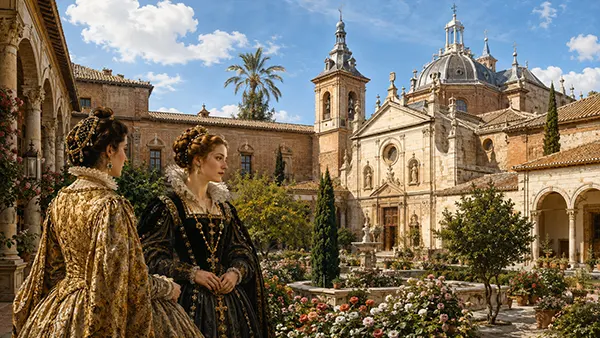
The history of Habsburg Madrid is often told through kings, royal palaces, councils and public ceremonies, yet two convents near the heart of the old court preserve a different view of how power worked. The Monastery of Las Descalzas Reales and the Royal Monastery of La Encarnación were religious houses, but they were also closely connected to royal women who used patronage, family networks, correspondence and ceremonial life to maintain influence within the Spanish monarchy. From Juana of Austria in the sixteenth century to later Habsburg princesses and professed nuns, these women created spaces where devotion and dynastic politics existed side by side. Seen together, the two monasteries make it possible to read Madrid not only as the seat of male sovereigns but also as a city shaped by queens, princesses, widows and religious women whose choices affected court culture, art and the memory of the dynasty.
Las Descalzas Reales: Juana of Austria Creates a Female Royal Centre
Las Descalzas Reales began with Juana of Austria, daughter of Emperor Charles V and sister of Philip II. Born in Madrid in 1535, she married João Manuel, heir to the Portuguese throne, but became a widow in 1554 shortly before the birth of their son Sebastian, the future king of Portugal. Juana returned to Spain and served as regent of Castile from 1554 to 1559 while Philip II was abroad. Her political experience matters because the convent she created was not the project of a woman detached from government. In 1557 she founded a community of Franciscan Poor Clares in the former palace where she had been born. Work adapting the building was completed in 1559, the year the religious community settled there. The foundation therefore emerged directly from the life of a woman who already understood court administration, diplomacy and dynastic responsibility.
The choice of the old palace gave Las Descalzas an unusual character from the beginning. Juana did not simply give money to a religious institution and then leave it behind. She installed her own apartments in the complex, and her burial place was created in the chapel occupying the area associated with her birth. The building consequently preserved two identities at once: it was a cloistered convent governed by religious rules, but it also contained a royal residential sphere. This arrangement made it possible for women of the dynasty to spend long periods there without losing all connection with court society. Princesses and infantas stayed in the Cuarto Real, or royal apartments, while members of the convent lived under enclosure. The physical closeness of these worlds helps explain why Las Descalzas became far more than a private retreat for aristocratic women.
Its importance also came from the social position of the women connected with it. A Habsburg princess entering a convent did not cease to be a daughter, aunt, sister or cousin of rulers across Europe. Her family identity continued to shape whom she corresponded with, what gifts she received and which causes she could support. Las Descalzas therefore became a place where female religious life remained linked to the wider Habsburg family. The convent offered an accepted setting for women whose roles did not fit neatly into marriage and queenship, including widows and princesses who took vows. At the same time, the prestige of the house drew court officials, diplomats and patrons towards it. This combination of enclosure and access gave royal women a form of influence that was different from formal office but still visible in the political and cultural life of Madrid.
How Las Descalzas Became the Habsburgs’ “Other Court”
The expression “other court” is useful because Las Descalzas functioned as a parallel royal environment rather than as an isolated religious house. Patrimonio Nacional has used the idea to describe the network created there by women of the House of Austria during the sixteenth and seventeenth centuries. Empress Maria of Austria, daughter of Charles V and widow of Emperor Maximilian II, lived in the royal apartments after returning to Madrid. Her daughter Margarita entered the convent as Sor Margarita de la Cruz. Isabel Clara Eugenia, daughter of Philip II, was educated in this environment before becoming sovereign of the Spanish Netherlands with her husband, Archduke Albert. These women linked Madrid with Vienna, Brussels and other Habsburg centres through kinship, religious interests and the circulation of objects, news and requests.
Art patronage made those connections visible. Isabel Clara Eugenia later gave Las Descalzas the celebrated Eucharistic tapestry series based on designs by Peter Paul Rubens. The gift was not merely decoration for a wealthy convent. Large tapestries were costly objects associated with ceremony, status and dynastic representation, and their arrival connected a Madrid religious house to artistic production in the Habsburg Netherlands. Portraits, sculpture, precious objects and textiles accumulated in similar ways, often through gifts from women who wanted to preserve family memory or support a religious devotion. The collections therefore document personal relationships as much as artistic taste. A portrait could affirm kinship, a relic could express confessional identity, and a textile commission could demonstrate continued attachment to Madrid from hundreds of miles away.
Sor Ana Dorotea of Austria shows even more clearly that enclosure did not mean political silence. After joining Las Descalzas, she maintained close relations with relatives and court figures and corresponded with ambassadors, ministers, churchmen and Philip IV. She gradually took on responsibilities previously associated with her aunt Sor Margarita de la Cruz and became an important patron within the house. Her example changes the usual picture of a royal nun as someone who had withdrawn completely from public affairs. The convent limited movement, but letters, visitors, family ties and patronage allowed information to cross its walls. Women could recommend people, request favours, support artistic or devotional projects and maintain relationships with decision-makers. Their authority was informal, unequal and dependent on rank, yet it was real enough to make the monastery part of the working social geography of the Habsburg court.
La Encarnación: Queen Margarita Reworks the Model Near the Alcázar
Half a century after Juana’s foundation, Queen Margarita of Austria-Styria created another royal female convent close to the centre of government. Married to Philip III in 1599, Margarita belonged to the Styrian branch of the Habsburg family and brought her own strong religious interests to the Spanish court. In 1611 she promoted the foundation of La Encarnación, taking Las Descalzas as an important precedent. The location was deliberate: the new Augustinian Recollect convent stood near the royal Alcázar, the main residence of the monarchy before the present Royal Palace was built. The complex was designed so that palace and convent could be connected by a passageway, allowing the royal family to attend religious observances without making a public journey through the streets. The architecture therefore expressed a close institutional relationship between court and convent.
Margarita’s initiative also shows how royal women could shape Madrid through religious patronage. Founding a convent involved far more than financing a church. It required selecting a religious order, securing income, arranging privileges, choosing a site and defining a lasting relationship between the Crown and the community. La Encarnación became a royal patronage with obligations on both sides: the monarchy supported the house, while the community performed religious duties connected with its founders and successors. The Queen died in October 1611 and did not live to see the completed convent, which was officially inaugurated in 1616. Even so, the foundation remained identified with her wishes. Her project continued after her death because it had been placed within the legal, financial and ceremonial structures of the monarchy.
The passageway to the Alcázar is especially revealing because it made proximity tangible. Royal women did not need a formal council seat for their religious foundations to matter at court. A convent located beside the palace could host ceremonies, receive gifts, preserve dynastic memory and maintain personal relationships with the royal household. La Encarnación also became a setting for important court observances, including royal funeral rites in the seventeenth and eighteenth centuries. Its position near the Alcázar helped place female religious life within the ceremonial map of Madrid rather than beyond it. The later destruction of the old palace by fire in 1734 and nineteenth-century changes around Plaza de Oriente altered that physical relationship, but the original plan still explains why the monastery belonged so closely to the political landscape of Habsburg Madrid.
Mariana de San José and the Authority of Religious Women
Queen Margarita was not the only woman responsible for La Encarnación. The first prioress, Mariana de San José, was brought from the community of Discalced Augustinian nuns in Palencia to take charge of the new foundation. Before the permanent building was ready, the community was housed temporarily at Santa Isabel, and Mariana led the convent through this early stage. Her role is important because it prevents the story from becoming a simple account of a queen giving orders to passive nuns. Royal patronage provided resources and status, but a functioning religious house depended on women who organised daily life, maintained discipline, managed relationships with benefactors and interpreted the spiritual aims of the foundation. Mariana represented a form of female institutional authority grounded in religious office rather than dynastic birth.
Her surviving papers also help modern historians see that women’s religious leadership involved writing, administration and networks of communication. Patrimonio Nacional preserves material connected with Mariana, including correspondence, instructions and an incomplete autobiographical text. Such records matter because convent history is often reconstructed through documents produced by male officials, confessors or royal administrators. A woman’s own writings give a different perspective on the priorities and pressures inside a religious community. They show that female authority could be exercised through letters, rules, spiritual guidance and the careful management of relationships between convents. In this sense, La Encarnación adds another layer to Madrid’s women’s history: it brings a professional religious leader into the same story as queens and princesses.
The partnership between a queen and a prioress also illustrates how different kinds of female power could overlap without being identical. Margarita possessed rank, wealth and access to the Crown; Mariana possessed recognised authority inside her order and experience of religious reform. One could establish and endow a royal house, while the other could shape the community that gave the building its daily purpose. Their positions were constrained by monarchy, church law and social hierarchy, yet neither can be reduced to a decorative role. La Encarnación was produced through cooperation between court patronage and female religious governance. Looking at both women together makes the monastery more useful as a historical source because it shows how influence in early modern Madrid could operate through institutions, relationships and long-term foundations rather than only through public office.
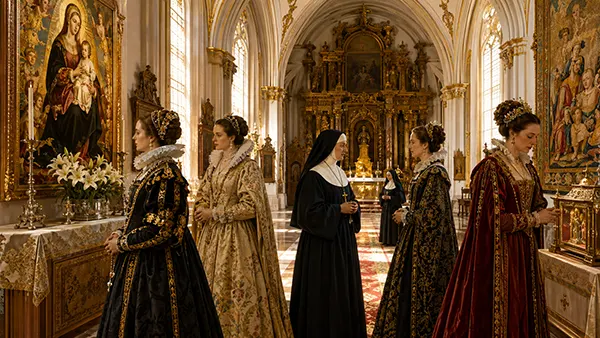
Art, Memory and Dynastic Networks Across the Two Monasteries
Las Descalzas and La Encarnación accumulated major collections because royal convents were also places of memory. Objects entered them through dowries, royal gifts, inheritances, diplomatic connections and devotional commissions. At Las Descalzas, paintings, tapestries, sculpture and precious objects were associated with several generations of Habsburg women. At La Encarnación, the collections include important seventeenth- and eighteenth-century painting and sculpture as well as an extensive reliquary. These works should not be treated only as museum pieces separated from their original context. In a convent, an image might be used during worship, a portrait might recall a deceased relative, and a reliquary might connect the community to wider Catholic networks. The meaning of the collections came from use, memory and relationships as much as from artistic quality.
This is particularly important for understanding women’s patronage. Early modern royal women often had fewer formal political offices than men of comparable rank, but they could commission works, direct gifts and determine how family members were remembered. Religious foundations gave those choices permanence. A queen or princess could associate her name with a chapel, an altar, a group of relics or a cycle of tapestries that remained in use after her death. Such acts were devotional, but they were also statements about family identity and status. They placed women inside the visual history of the monarchy. The fact that so many works connected with the female Habsburgs survive in these monasteries means that the buildings preserve evidence of choices made by patrons whose influence can be harder to see in official political records.
The two houses also show that Madrid’s court was international. Habsburg marriages linked the Spanish monarchy with Portugal, the Holy Roman Empire, the Austrian lands, France and the Low Countries. Women frequently moved across these territories as brides, widows or religious figures, and objects moved with them or followed the same family routes. Isabel Clara Eugenia’s connection between Brussels and Las Descalzas is one clear example, but the broader pattern is just as important. A Madrid convent could preserve gifts made elsewhere in Europe and maintain devotional practices shared across the dynasty. The city’s female religious houses therefore belonged to a network that extended well beyond Spain. Their walls enclosed communities, but their collections and family relationships reveal movement across an international monarchy.
Reading Madrid’s Women’s History Through the Monasteries in 2026
For a visitor or reader in 2026, the value of Las Descalzas and La Encarnación lies in this combination of surviving space, objects and documented lives. Both are preserved within Patrimonio Nacional, and their collections allow the history of the Habsburg court to be approached through women who are easily pushed to the margins of a king-centred narrative. Las Descalzas still communicates the unusual union of convent and royal residence created by Juana of Austria, while La Encarnación preserves the memory of Queen Margarita’s foundation beside the old Alcázar. Guided access also means that these places can be understood as historic interiors rather than only as façades in central Madrid. Their rooms make relationships between court ceremony, religious practice and patronage easier to grasp.
They also encourage a more precise way of writing women back into political history. It would be misleading to claim that royal nuns or queens exercised the same authority as the king, or that a convent was a hidden government operating behind palace walls. Their influence depended heavily on birth, family access, reputation and the willingness of others to respond to them. Yet it is equally misleading to describe them as politically absent simply because they lacked formal offices. Correspondence, recommendations, patronage, religious foundations, ceremonial roles and dynastic relationships were all recognised ways of exercising influence in early modern court society. The monasteries preserve evidence for these practices and show how female agency worked within, rather than outside, the structures of Habsburg monarchy and Catholic religion.
Taken together, Las Descalzas Reales and La Encarnación change the map of Habsburg Madrid. The Royal Alcázar, churches, squares and council buildings remain essential to the city’s history, but these two monasteries show that court life also operated through spaces created and inhabited by women. Juana of Austria used a former palace to establish a community that became a dynastic centre. Empress Maria, Sor Margarita de la Cruz, Isabel Clara Eugenia and Sor Ana Dorotea sustained international family and patronage networks around Las Descalzas. Queen Margarita and Mariana de San José gave La Encarnación its royal and religious foundations. Their stories make the “other court” more than a memorable phrase: it describes a part of Madrid where spiritual life, family strategy, artistic patronage and female authority met in lasting institutions.