Royal Palace of Riofrío and the New Museum of Natural Heritage: A Royal Residence in Over 600 Hectares of Forest
The Royal Palace of Riofrío is one of the most unusual royal sites in Spain because the building and its landscape cannot really be separated. Set near Segovia, within a historic woodland estate of about 640 hectares, the palace was conceived in the eighteenth century as a private royal retreat but spent more than a century without permanent residents. Its later history linked it to royal mourning, hunting, nineteenth-century interiors and, from the 1960s, a specialist hunting museum. In 2026, Riofrío is undergoing another important change: Patrimonio Nacional has renovated the visitor reception area and is transforming the former hunting displays into a new Museum of Natural Heritage, intended to explain the ecological value of the estate as well as its historical relationship with people, wildlife and royal use. This combination of palace, museum and protected forest makes Riofrío a particularly useful place for understanding how royal heritage in Spain extends beyond architecture and collections into managed historic landscapes.
Why Riofrío Was Built for Elisabeth Farnese
The origins of Riofrío lie in a hunting landscape used by the Spanish monarchy before the palace existed. The estate belonged to the Marquis of Paredes, and the Crown had used the land as a hunting ground from the 1720s. After the death of Philip V in 1746, his widow, Elisabeth Farnese, found herself in a very different political position. In 1751 she acquired the Riofrío estate and enlarged it through further purchases and exchanges. Her aim was not simply to build another seasonal residence. Riofrío offered a domain over which she could exercise greater personal control after leaving the centre of court life, and Patrimonio Nacional also links the project to her wish to provide her youngest son, Infante Luis, with a country residence. The setting close to the royal residence at La Granja de San Ildefonso made the site convenient, but its enclosed woods and relative isolation gave it a character of its own.
Elisabeth Farnese commissioned the palace during the reign of Ferdinand VI, when her influence at court had diminished. The project was ambitious: the palace was intended as the centre of a larger royal complex with service buildings, stables, a church, a theatre and other dependencies. In practice, only part of that wider plan was realised. The political situation changed again when Elisabeth’s eldest surviving son became King Charles III in 1759. She returned to a more prominent role at court, and the private retreat for which Riofrío had been conceived lost much of its original purpose. She never settled there. This explains one of the great paradoxes of the site: a substantial royal residence was built with careful planning and considerable expense, yet it did not develop into a permanently inhabited court in the manner of La Granja, Aranjuez or other major royal residences.
The history of the estate also explains why the surrounding forest is not merely scenery. Hunting shaped the choice of the site, the boundaries of the property and the later use of the residence. The woodland was enlarged in subsequent reigns, including those of Charles IV and Isabella II, and it survived the nineteenth-century disposal of many other royal properties. Today the estate remains enclosed by a masonry wall and preserves a large area of woodland on the northern side of the Sierra de Guadarrama. The result is a rare continuity between an eighteenth-century royal estate and a modern protected natural area. Visitors arriving at Riofrío therefore encounter the same basic relationship that defined the site from the beginning: a palace standing within a managed forest, rather than a palace surrounded mainly by formal gardens or an urban setting.
An Italian-Influenced Palace with an Unusually Unified Design
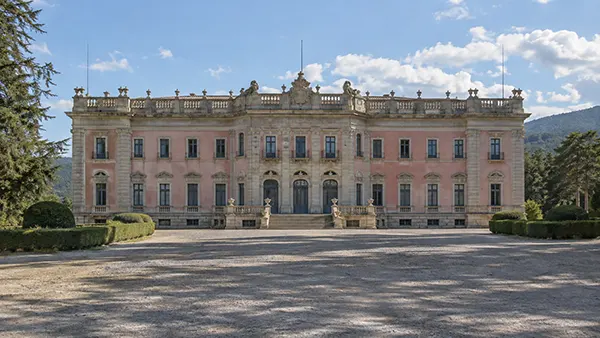
The design is associated above all with the architect Virgilio Rabaglio, who worked for Elisabeth Farnese in the early 1750s. Riofrío follows an Italian-influenced Baroque approach, but its appearance is restrained compared with many royal buildings of the period. The palace has a square plan, three main storeys visible on the façades and a central courtyard. Its long horizontal lines, repeated windows and limited variation between the four sides give the building an unusually unified appearance. Patrimonio Nacional describes Riofrío as the most Roman of Spain’s royal palaces, a reference to the sober proportions and regularity of its architecture rather than to direct imitation of one specific ancient building. The warm pink façades, pale stone framing and balustraded roofline add colour without breaking the overall symmetry.
One of the clearest expressions of that symmetry is inside the entrance, where two monumental staircases face one another. The arrangement creates a formal route to the principal floor while preserving the balanced plan that governs the whole building. Rabaglio did not complete the project alone: after his early death in 1753, other architects continued the works, which extended through the 1750s and into the early 1760s. This succession of designers did not destroy the coherence of the original idea. The completed palace still reads as a single architectural statement, which is one reason it differs from royal residences repeatedly enlarged over several centuries. Riofrío’s architecture is therefore easier to understand as a planned whole, even though its interior decoration reflects later periods and later occupants.
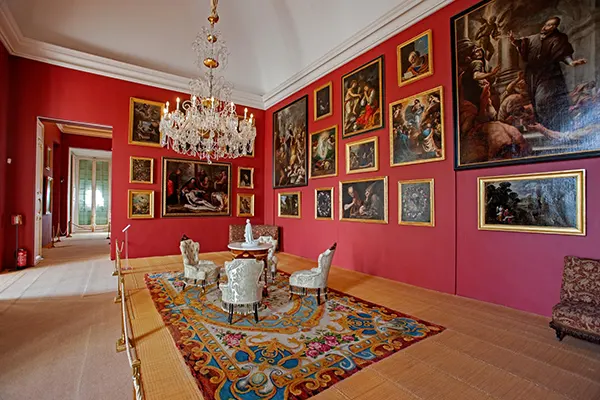
The contrast between the eighteenth-century shell and the nineteenth-century interiors is central to the visitor experience. During a major programme of historical reinstatement, Patrimonio Nacional returned several rooms to functions associated with the nineteenth century and increased the number of works on display to more than 500 paintings, pieces of furniture, textiles and decorative objects from the seventeenth to nineteenth centuries. Recovered spaces included the Billiard Room, the service room beside the dining room with its original dumbwaiter, the bedroom associated with Francisco de Asís and the Oratory. In the latter, the altar was made visible again and a cycle of 149 small paintings representing episodes from the life of Christ was reinstated. Fine-wood furniture, mirrors, French porcelain, clocks and textiles now help explain Riofrío not as an empty architectural monument, but as a royal interior shaped mainly by the nineteenth century.
A Palace That Waited More Than a Century for Its Residents
Riofrío is often described as a palace that remained without guests for more than a hundred years, and that long period of limited use is essential to its identity. Elisabeth Farnese never made it her home, and the broader royal complex originally envisaged around the main building was never completed. The palace continued to serve the Crown, particularly in connection with hunting, but it did not become a regular residential centre. This relative inactivity helped preserve the clarity of the eighteenth-century structure while leaving later generations to define how the rooms should be used. When royal occupation finally came, it was temporary rather than permanent, and the two best-known nineteenth-century residents brought very different personal circumstances to the palace.
Francisco de Asís de Borbón, husband of Queen Isabella II, spent periods at Riofrío in the second half of the nineteenth century and played an important part in giving the residence the furnished character that visitors associate with it today. Rooms linked with his stay reflect the domestic side of royal life rather than only ceremony. Painting, reading, writing, billiards and hunting all formed part of the culture of the residence and its surroundings. This period matters because much of the current historical presentation seeks to recover the palace as it functioned in the nineteenth century, not to reconstruct an imagined eighteenth-century household that never really existed there. The result is a residence whose architecture belongs to Elisabeth Farnese’s generation but whose lived interiors are largely explained through later Bourbon use.
The second famous period of occupation came in 1878, after the death of Queen María de las Mercedes, the first wife of Alfonso XII. The young king withdrew to Riofrío while mourning her death, giving the palace a sombre place in Spanish royal history. His stay was brief, but it became one of the events most closely associated with the building because Riofrío’s isolation suited a period of private grief away from Madrid. The episode also reinforces the idea of the palace as a retreat rather than a centre of government. Across the nineteenth century, Riofrío remained tied to hunting and temporary residence, yet those short occupations provided the personal history needed to interpret its rooms. They also explain why later museum displays have had to balance architecture, royal biography, decorative arts and the natural environment rather than treating the site as a single-theme monument.
From the Hunting Museum to the Museum of Natural Heritage
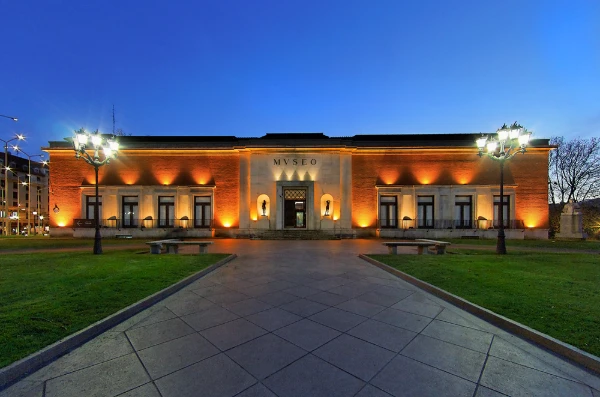
In the 1960s, Riofrío acquired a new public role. Part of the principal floor was organised as a royal residence with nineteenth-century decoration, while another part became the Museo de la Caza, or Hunting Museum. Opened in 1965, it became one of Spain’s best-known collections devoted to hunting. Its displays included historic hunting material, paintings, mounted animals and carefully staged dioramas. The dioramas were important not only as zoological presentations but also as examples of mid-twentieth-century museum design: taxidermist José María Benedito worked on them, while scenic specialist Emilio Ruiz del Río helped create their settings. For decades, this museum reflected the historical importance of hunting at Riofrío, but by the twenty-first century the narrow focus on hunting no longer explained the full environmental value of the estate or the conservation work carried out there.
The new Museum of Natural Heritage is intended to broaden that story. Project documentation for the refurbishment calls for a complete renewal of the former hunting museum, restoration and historical contextualisation of its dioramas, and a wider interpretation of the natural spaces managed by Patrimonio Nacional. The change does not erase the hunting history of Riofrío; instead, it places that history inside a larger account of habitats, wildlife, landscape management and conservation. This is especially relevant at Riofrío because the museum stands inside the very ecosystem it is meant to explain. A visitor can see deer or fallow deer in the estate, walk through oak woodland and then encounter museum material that gives those observations historical and ecological context. The new approach therefore links the collections more directly to the place where they are displayed.
The museum forms part of a wider improvement project at Riofrío financed with €2.36 million from Spain’s Recovery, Transformation and Resilience Plan. The palace closed on 10 February 2026 while the visitor reception centre was rebuilt, then reopened on 14 April with improved reception, ticketing, lighting, thermal comfort and accessibility. Patrimonio Nacional originally announced the Museum of Natural Heritage for June and later referred more generally to a summer 2026 opening. However, current visitor information still states that the palace is undergoing remodelling and that some rooms are closed. As of September 2026, the official sources checked do not provide a separate confirmation that every part of the new museum is open to the public. Visitors should therefore check the current ticket information before travelling if access to the new museum is the main reason for the visit.
The 640-Hectare Forest Around the Palace
The Bosque de Riofrío covers about 640 hectares and is one of the strongest reasons to treat the site as more than an architectural visit. It lies around nine kilometres from Segovia and about fifteen kilometres from San Ildefonso, within the municipality of the Real Sitio de San Ildefonso. The land rises from roughly 950 to 1,086 metres and is crossed by the Río Frío. This variation in altitude, water and soil supports four principal ecological settings identified by Patrimonio Nacional: holm-oak woodland, juniper woodland, Pyrenean-oak woodland and ash groves, particularly along the river corridor. Other trees include Portuguese oak, Montpellier maple, willow and poplar, while broom, thyme, rosemary and Spanish lavender are common among the shrubs. The forest therefore changes noticeably over short distances instead of presenting one uniform type of vegetation.
Wildlife is equally important. Patrimonio Nacional lists 102 catalogued animal species in the forest, including more than 50 species of birds. Griffon vultures and black vultures are among the most notable birds associated with the area, while the mammals include red deer, fallow deer, rabbits, badgers, foxes, genets and weasels. Deer and fallow deer are particularly visible symbols of Riofrío because large herbivores have been part of the estate’s history for centuries. Their presence also requires active management: recent Patrimonio Nacional reports describe censuses of ungulates, habitat work, veterinary monitoring and measures intended to keep wildlife populations compatible with the condition of the woodland. These activities show how the present-day estate combines public enjoyment with practical conservation rather than treating the forest as a static historical backdrop.
The forest also has formal environmental protection. It lies within the natural-resources planning area of the Río Frío basin and forms part of the European Natura 2000 network. It is included in the Valles del Voltoya y el Zorita Special Protection Area for birds and in a Special Area of Conservation. Public access is therefore organised rather than unrestricted. Around five hectares beside the palace are set aside for clearly defined recreational use, with viewpoints, interpretation panels, benches and tables, while the wider estate remains managed for heritage and conservation purposes. The combination of legal protection, long royal ownership and restricted development has allowed Riofrío to retain a landscape that differs markedly from the more intensively altered plains around it. This ecological continuity is precisely what gives the new Museum of Natural Heritage a strong local basis.
Planning a Visit to Riofrío in 2026
For the 2026 season, the Royal Palace of Riofrío is open from Tuesday to Sunday and closed on Mondays. Patrimonio Nacional lists winter hours, from October to March, as 10:00 to 18:00, and summer hours, from April to September, as 10:00 to 19:00; the ticket office and access to the palace close one hour earlier. Guided visits are also scheduled on selected days. The official ticket system currently lists a basic self-guided admission of €5 and a reduced rate of €2 while the improvement works continue, although prices and the rooms included can change as the refurbishment progresses. There are also several full-day closure dates during 2026 and additional closures can occur for official events. Checking the official timetable shortly before the journey is therefore sensible, especially during the transition to the new museum.
The easiest outdoor addition to the palace visit is the Senda del Mirador. This circular route is 1.5 kilometres long, has a low level of difficulty and takes about 25 minutes at a relaxed pace. It is signposted and intended for independent use, including by families with children. The path begins near the viewpoint on the north side of the palace, passes recreational areas and water features such as the Fuente del Pocillo and Fuente del Rey, and returns beside the palace walls. Views include the wooded estate and the Mujer Muerta profile of the Sierra de Guadarrama. Patrimonio Nacional specifically notes that deer and fallow deer can often be seen along this short route, though wildlife sightings can never be guaranteed. The path gives visitors an immediate sense of the landscape discussed inside the palace and museum.
Riofrío works best as a combined cultural and natural visit rather than as a quick stop for the façade alone. The address used by the official ticket service is Bosque de Riofrío, Navas de Riofrío, 40420, Segovia, and there are two parking areas at the site. Navas de Riofrío also has a railway stop, with the forest entrance roughly a kilometre away on foot, though connections should be checked in advance. Allowing time for the palace, the short forest trail and the visitor reception area makes it easier to understand why the estate is distinctive: eighteenth-century dynastic ambition, nineteenth-century royal life, the legacy of the Hunting Museum and modern nature conservation are all present within the same boundary. In 2026, the ongoing museum renewal adds another layer to that history, turning Riofrío into a case study in how an old royal hunting estate can be interpreted for contemporary visitors without separating the building from the forest that shaped it.