Museo Sorolla (House-Studio) and Its Garden: The Artist’s Domestic Life as Part of Madrid’s Urban History
In the Chamberí district of Madrid, a short walk from Paseo de la Castellana, stands one of the city’s most intimate cultural landmarks: the former home and studio of Joaquín Sorolla y Bastida (1863–1923). Today known as Museo Sorolla, the house preserves not only paintings, sketches and personal objects, but also a way of living that reflects the aspirations of Spain’s liberal bourgeoisie in the early twentieth century. Built between 1910 and 1911 and opened as a museum in 1932, the property offers a rare opportunity to see how artistic practice, family life and urban growth intertwined at a crucial moment in Madrid’s transformation into a modern capital.
The Creation of a House-Studio in Early Twentieth-Century Madrid
By the first decade of the twentieth century, Joaquín Sorolla was already internationally recognised. His exhibitions in Paris, London and especially New York (1909) secured financial stability and social prestige. With this success, he decided to commission a purpose-built residence that would combine domestic comfort with professional functionality. The plot he chose in what was then a relatively new residential area of Madrid reflected both the city’s expansion northwards and the desire of affluent families to live in quieter, greener surroundings.
The architect Enrique María Repullés y Vargas designed the house according to Sorolla’s practical needs. The ground floor accommodated the principal studio, conceived with high ceilings and large north-facing windows to provide steady natural light. Adjacent rooms allowed for the storage of canvases and the reception of visitors, patrons and fellow artists. The upper floors were reserved for family life, ensuring a clear yet fluid division between public and private spaces.
What makes the building significant in urban terms is its hybrid character. It is neither a grand aristocratic mansion nor a modest artisan dwelling. Instead, it represents a confident middle-class home shaped by professional ambition. The architecture reflects Madrid’s transition from a traditional court city to a cosmopolitan centre where culture, commerce and domestic modernity converged.
Architecture, Light and the Logic of the Studio
Sorolla’s painting is inseparable from light, and the studio was engineered accordingly. The orientation of the main workspace minimised direct glare while ensuring consistent illumination throughout the day. Movable curtains and adjustable panels allowed the artist to control tonal effects, particularly important for large-scale commissions such as the “Vision of Spain” series created for the Hispanic Society of America.
The interior layout demonstrates how early twentieth-century artists negotiated the boundary between creation and representation. Clients could be received in a dignified setting without intruding upon the intimacy of the family quarters. This spatial choreography mirrors the professionalisation of art in Spain, where painters increasingly operated within international markets while remaining rooted in local cultural life.
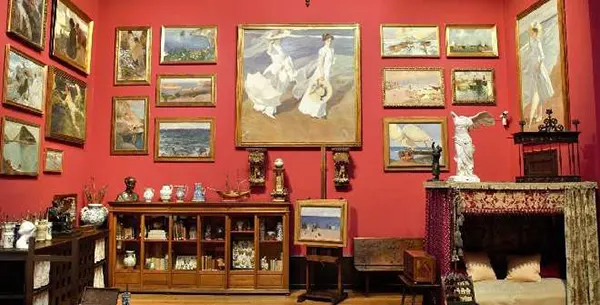
Today, visitors can still sense this functional clarity. Easels, brushes and original furnishings have been preserved, allowing the studio to be read as a working environment rather than a reconstructed stage set. It stands as documentary evidence of how an artist’s daily routine was embedded within the architectural fabric of a growing European capital.
The Garden as a Living Extension of the House
The garden is not a decorative afterthought but a central component of the property. Sorolla personally designed it, drawing inspiration from Andalusian patios, the Generalife in Granada and traditional Spanish courtyard gardens. Divided into three interconnected sections, the space combines tiled fountains, pergolas, orange trees and carefully planned sightlines that frame both vegetation and architectural elements.
In an increasingly dense city, such a private garden represented both aesthetic choice and social statement. It echoed a broader cultural movement in Spain that sought to reconnect with regional artistic traditions while embracing modern lifestyles. For Sorolla, who frequently painted outdoor scenes filled with Mediterranean brightness, the garden provided immediate access to motifs of light, water and foliage without leaving home.
The garden also reflects Madrid’s climatic realities. Shaded walkways and water features helped mitigate summer heat, demonstrating practical adaptation rather than romantic nostalgia. In this sense, the space functions as a microcosm of Mediterranean urban design principles translated into a domestic setting.
The Garden in Sorolla’s Work and Daily Routine
Several paintings created between 1916 and 1920 depict members of Sorolla’s family within the garden. These works reveal the site as both private refuge and artistic laboratory. The repetition of arches, tiled benches and fountains across canvases confirms that the garden was not merely ornamental but integral to his visual vocabulary.
Beyond artistic production, the garden structured everyday life. Family gatherings, informal conversations with guests and moments of rest unfolded in its shaded corners. This interplay between work and leisure underscores how domestic environments shaped creative output. The house and garden together formed a self-contained universe in which professional discipline coexisted with familial intimacy.
In contemporary Madrid, where green space is at a premium, the preserved garden offers insight into early twentieth-century attitudes towards health, aesthetics and privacy. It reveals how cultivated nature was woven into urban identity long before environmental discourse became widespread.
From Private Residence to Public Museum
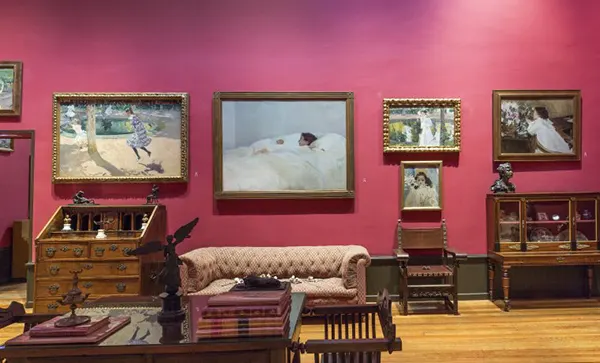
After Sorolla’s death in 1923, his widow Clotilde García del Castillo played a decisive role in safeguarding his legacy. In 1925 she bequeathed the house and much of its contents to the Spanish state with the intention of creating a museum. Museo Sorolla officially opened to the public in 1932, becoming one of the few artist house-museums in Spain preserved almost intact.
The institution survived the upheavals of the Spanish Civil War and subsequent political changes, maintaining its character as an intimate cultural space rather than a large-scale gallery. Its collection includes not only oil paintings but also drawings, personal correspondence, ceramics and furniture. Together, these objects allow historians to reconstruct the social networks and domestic customs of Madrid’s educated elite during the Restoration period.
As of 2026, Museo Sorolla operates under Spain’s Ministry of Culture and continues to undergo careful conservation work to protect both the building and the garden. Temporary exhibitions, educational programmes and research initiatives position the museum as an active participant in Madrid’s cultural life rather than a static memorial.
The House-Museum in the Context of Urban Memory
House-museums occupy a particular place in European heritage practice. Unlike purpose-built galleries, they preserve the scale and atmosphere of lived experience. In the case of Museo Sorolla, the authenticity of rooms, furnishings and garden layout allows visitors to grasp how art was embedded in domestic routine rather than isolated within institutional walls.
Within Madrid’s broader urban narrative, the site illustrates the city’s northward expansion and the consolidation of Chamberí as a respectable residential district in the early twentieth century. The house stands as architectural testimony to a period when artistic success enabled social mobility and shaped patterns of urban habitation.
By preserving the intersection of family life, artistic labour and urban development, Museo Sorolla contributes to a more nuanced understanding of Madrid’s history. It demonstrates that the story of a city is not written solely in grand boulevards and official monuments, but also in private interiors where creativity and everyday life quietly intersected.