Murallas Romanas de Lugo: the only Roman walls you can walk around in full
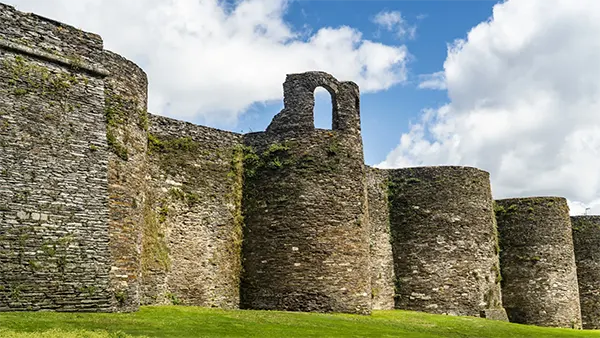
The Roman Walls of Lugo are not an isolated monument or a preserved ruin hidden behind barriers. They form a complete, walkable ring around the historic centre of the city and remain fully integrated into everyday urban life. Unlike most Roman fortifications, which survive only in fragments, Lugo’s walls allow visitors to experience their original scale, function, and defensive logic by walking the entire perimeter.
What makes the Roman Walls of Lugo unique in Europe
The defining feature of Lugo’s walls is their total continuity. The fortification forms a closed circuit of just over 2.2 kilometres, enclosing the old city exactly as it did in Roman times. This uninterrupted outline is exceptionally rare and is the main reason the monument holds UNESCO World Heritage status.
Constructed between the late third and early fourth centuries AD, the walls were part of Rome’s strategy to protect key administrative centres in the northwest of the Iberian Peninsula. Lugo, known then as Lucus Augusti, served as a strategic hub rather than a frontier outpost, which explains the scale and solidity of its defences.
Another distinctive aspect is functionality. The wall-top is not restricted or ceremonial; it operates as a public walkway. Locals use it for daily walks, exercise, and shortcuts across the city, reinforcing the idea that this is a living structure rather than a frozen historical exhibit.
Architecture, materials, and defensive design
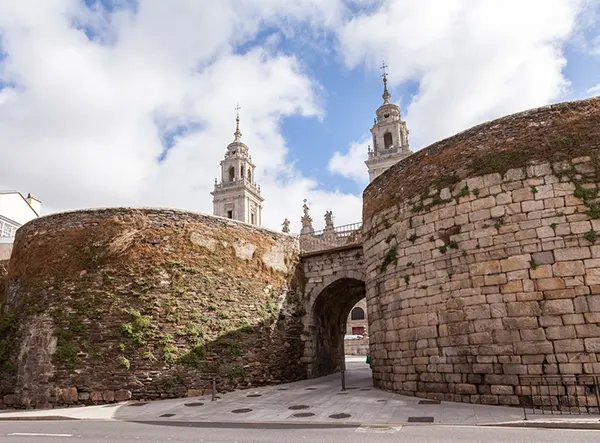
The walls were built using locally available stone, mainly granite and slate, combined with Roman concrete techniques. Their average height ranges between eight and ten metres, while the width of the ramparts is sufficient for comfortable pedestrian movement, even in sections with higher foot traffic.
Along the exterior face, the fortification is reinforced by 85 semi-cylindrical towers. These were designed to allow defenders to control blind spots and improve visibility along the curtain wall. Their regular spacing creates a visual rhythm that becomes especially noticeable when walking the perimeter.
The wall includes ten gates. Five are original Roman openings, while the others were added in later centuries to adapt the structure to the city’s evolving layout. The contrast between ancient masonry and later interventions offers a clear, readable timeline of Lugo’s urban development.
Walking the full circuit: what to expect in practice
Completing a full walk along the Roman walls is both manageable and rewarding. The total distance makes it accessible to most visitors without requiring special preparation, while still feeling substantial enough to provide a real sense of journey rather than a brief stroll.
The experience changes depending on the section. Some stretches open towards green areas and river valleys outside the walls, while others overlook dense historic streets and rooftops inside the city. This alternating perspective keeps the walk engaging and prevents visual monotony.
Because access points are distributed around the circuit, it is easy to break the walk into segments. Visitors can descend into the old town for museums, cafés, or rest stops and later rejoin the wall without repeating the same route.
Access points, timing, and visitor flow
Entry to the wall-top is possible via multiple staircases and ramps, making it easy to start the walk from almost any part of the historic centre. Ramps are particularly useful for visitors seeking step-free access, although not all entrances are fully level.
A steady pace without long stops usually allows a full circuit to be completed in about an hour. Those who pause for photography, views, or interpretation panels should allow closer to ninety minutes, especially during busy travel periods.
Early mornings and late afternoons tend to be the quietest times to walk the walls. These hours also offer softer light, which enhances both city views and stone textures, making them ideal for photography and unhurried exploration.
The role of the walls in modern Lugo
Rather than isolating the historic centre, the walls continue to organise the city’s movement. Gates function as natural transition points between neighbourhoods, while the elevated walkway acts as a linear viewpoint that helps visitors orient themselves spatially.
The Roman Walls also play a central role in Lugo’s cultural identity. Public events, guided walks, and educational programmes regularly reference the fortification as a symbol of continuity between ancient and modern life in the city.
Preservation efforts focus on maintenance rather than reconstruction. This approach ensures that the walls remain authentic, with visible signs of age and repair that reflect centuries of use rather than a single restored moment.
Why the walls matter beyond tourism
From a heritage perspective, Lugo’s walls provide a rare opportunity to study Roman urban defence in situ. Their completeness allows historians and archaeologists to analyse not just isolated features, but the full defensive system as it was intended to function.
For residents, the walls are part of everyday routines rather than a distant landmark. This constant interaction has helped preserve the structure, as public use creates social value and reinforces long-term care.
For visitors, the experience goes beyond sightseeing. Walking the entire perimeter offers a physical understanding of scale, control, and movement that no ground-level visit can replicate, making the Roman Walls of Lugo one of the most immersive ancient monuments in Spain.