Teruel and Mudejar Architecture: Brick Towers, Ceramics and the Cultural Synthesis of Aragon
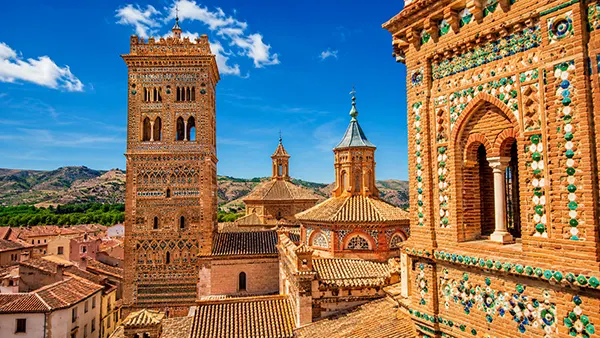
Teruel is one of Spain’s most distinctive historic cities, recognised worldwide for its exceptional collection of Mudejar monuments. Located in the autonomous community of Aragon, the city preserves an architectural tradition that developed between the 12th and 16th centuries, when Islamic artistic knowledge continued to flourish under Christian rule. Rather than replacing earlier construction techniques, local craftsmen combined decorative Islamic methods with Christian religious architecture, producing buildings unlike those found elsewhere in Europe. Today, Teruel’s towers, churches and ceramic ornamentation are protected as UNESCO World Heritage monuments and remain among the finest surviving examples of Aragonese Mudejar architecture.
The Historical Origins of Mudejar Architecture in Teruel
The history of Teruel began in 1171, when King Alfonso II of Aragon founded the city during the Christian Reconquista. Although political authority changed, many Muslim artisans remained in the region. These skilled builders, known as Mudejars, continued practising traditional construction methods while adapting their work to Christian commissions. Their expertise introduced geometric ornamentation, decorative brickwork and glazed ceramics into churches, towers and civic buildings that served a predominantly Christian population.
Unlike Gothic cathedrals elsewhere in Europe, where carved stone dominated architectural design, Teruel relied heavily on locally produced brick. Brick was readily available, economical and highly adaptable, allowing builders to create intricate decorative surfaces without expensive sculptural work. The resulting façades display repeating geometric motifs, blind arches, diamond-shaped patterns and ornamental friezes that remain remarkably well preserved centuries later.
Aragon became the principal centre of Mudejar architecture because Christian rulers encouraged experienced Muslim craftsmen to continue their work instead of replacing them. This peaceful coexistence created a unique artistic language that reflected cultural exchange rather than complete separation. Teruel eventually became one of the strongest expressions of this architectural identity, preserving monuments that clearly illustrate the interaction between Christian patronage and Islamic craftsmanship.
UNESCO Recognition and International Importance
UNESCO first included the Mudejar Architecture of Teruel on the World Heritage List in 1986, acknowledging the city’s outstanding artistic value. In 2001, the designation expanded to include additional monuments across Aragon, recognising the wider regional significance of this architectural tradition. These sites represent one of the most complete surviving collections of medieval Mudejar buildings anywhere in the world.
The recognition reflects more than architectural beauty. UNESCO identified these monuments as exceptional examples of cultural interaction, where different religious communities influenced one another through construction techniques, decorative traditions and artistic innovation. Rather than preserving isolated Islamic or Christian styles, Teruel demonstrates how both traditions evolved together over several centuries.
Today, conservation specialists continue monitoring these monuments using modern restoration methods that preserve original brickwork, ceramic tiles and timber structures wherever possible. Restoration projects prioritise authentic materials, ensuring that repairs remain faithful to medieval construction techniques while protecting the buildings for future generations.
The Iconic Brick Towers and Their Architectural Features
Teruel is especially famous for its remarkable brick towers, which dominate the historic skyline. Among the most celebrated examples are the Tower of San Martín, the Tower of San Salvador, the Tower of San Pedro and the Cathedral Tower. Although each structure possesses individual characteristics, all share the decorative vocabulary that defines Aragonese Mudejar architecture.
These towers served practical as well as symbolic purposes. Besides functioning as bell towers for nearby churches, they acted as visual landmarks that reinforced the city’s religious identity. Their square bases gradually rise through multiple levels decorated with ceramic inlays, blind windows, interlaced brick patterns and ornamental arches, creating striking vertical compositions visible from across the old town.
One of the most remarkable engineering achievements lies inside these towers. Several contain internal staircases arranged around a central hollow space, allowing access to the upper levels without compromising structural stability. This design reflects sophisticated medieval engineering combined with decorative refinement.
The Tower of San Martín and the Tower of El Salvador
The Tower of San Martín, completed during the early 14th century, stands among Teruel’s finest architectural achievements. Built primarily from brick, it features glazed ceramic inserts in green and white, geometric brick reliefs and horseshoe-inspired decorative elements inherited from Islamic artistic traditions. Every elevation presents a carefully balanced composition that changes subtly as light moves across the façade throughout the day.
The nearby Tower of El Salvador, dating from the same century, follows a similar decorative approach while incorporating its own structural solutions. Visitors may climb the interior staircase to enjoy panoramic views across Teruel’s medieval streets, churches and surrounding Aragonese landscape. Along the ascent, exhibitions explain the tower’s construction methods, historical context and restoration work.
Although both towers share many stylistic characteristics, careful observation reveals differences in decorative patterns, window arrangements and ceramic placement. These distinctions demonstrate that medieval craftsmen valued creativity and adaptation rather than reproducing identical designs from one project to another.
Ceramic Decoration and the Artistic Identity of Aragon
Decorative ceramics are among the defining characteristics of Teruel’s Mudejar monuments. Rather than serving only an ornamental purpose, glazed tiles protected brick surfaces from weathering while introducing colour and visual rhythm to otherwise monochrome structures. Green, white and occasionally dark blue glazes reflected sunlight and created striking contrasts against the warm reddish tones of locally produced bricks. This practical combination of durability and decoration became one of the signatures of Aragonese architecture.
Most ceramic pieces were manufactured by specialised workshops operating throughout medieval Aragon. Craftsmen shaped each tile by hand before applying mineral-based glazes and firing them in kilns at carefully controlled temperatures. Because every production cycle introduced slight variations in colour and texture, no two decorative surfaces are completely identical. These subtle differences give Teruel’s monuments an authentic handcrafted appearance that modern industrial materials cannot replicate.
Geometric organisation played a central role in ceramic decoration. Rather than depicting human figures, artisans relied on stars, diamonds, zigzag bands, interlocking polygons and repeating vegetal motifs. These compositions reflected Islamic artistic traditions while blending naturally with Christian ecclesiastical architecture. The result was an original decorative language that respected religious preferences while encouraging artistic innovation.
Cathedral of Santa María de Mediavilla: The Masterpiece of Teruel
The Cathedral of Santa María de Mediavilla represents the highest achievement of Mudejar architecture in Teruel. Originally established during the 12th century and later transformed throughout the medieval period, the cathedral combines Romanesque foundations, Gothic spatial organisation and Mudejar decorative craftsmanship within a single monument. This unusual mixture illustrates how architectural styles evolved gradually rather than replacing one another entirely.
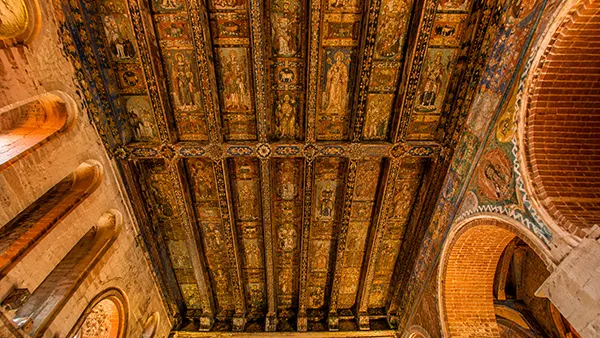
Its most celebrated feature is the extraordinary painted wooden ceiling, known as the Artesonado. Created during the 13th century, the ceiling is often described as one of the finest surviving examples of medieval wooden craftsmanship in Europe. Hundreds of painted panels portray musicians, craftsmen, nobles, mythical creatures, animals and scenes from everyday life, providing valuable insight into medieval society as well as exceptional artistic quality.
The cathedral tower complements the richly decorated interior through elaborate brick construction and ceramic ornamentation visible from throughout the historic centre. Together, the tower, ceiling and surrounding architectural details demonstrate how builders successfully combined structural engineering, decorative artistry and religious symbolism into a unified architectural composition. Even today, the cathedral remains one of Spain’s most significant monuments for understanding the cultural history of medieval Aragon.