Las Médulas in León: How Roman Gold Mining Became a Cultural Landscape
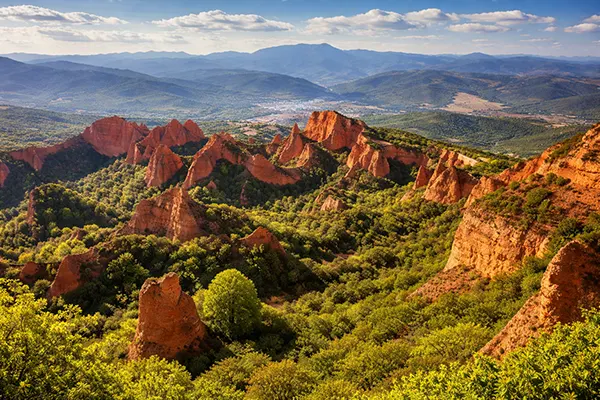
Las Médulas, located in the province of León in north-west Spain, is one of the most striking examples of how human activity can reshape nature and, over centuries, become part of it. What was once the largest open-pit gold mine in the Roman Empire has evolved into a protected cultural landscape and a UNESCO World Heritage Site. Today, the area reflects not only ancient engineering ingenuity but also the long-term interaction between people and environment.
Roman Engineering and the Scale of Gold Extraction
The origins of Las Médulas date back to the 1st century AD, when the Romans began extracting gold using an advanced hydraulic mining technique known as ruina montium. This method involved directing large volumes of water into the mountains to collapse them from within, allowing access to gold deposits. It required a sophisticated system of canals, reservoirs and tunnels built across dozens of kilometres.
To support this operation, the Romans constructed an extensive network of water channels that brought meltwater from nearby mountains. Some of these channels stretched over 100 kilometres, demonstrating a remarkable understanding of terrain, gradients and water flow. The scale of the infrastructure suggests that thousands of workers were involved, including local populations and enslaved labourers.
Historical estimates indicate that Las Médulas produced significant quantities of gold for the Roman Empire over approximately two centuries. The mining activity dramatically altered the landscape, creating the distinctive red cliffs, caves and irregular formations that are still visible today.
Environmental Impact and Early Landscape Transformation
The mining process had a profound environmental effect, as entire sections of mountains were dismantled through hydraulic pressure. Forests were cleared to build infrastructure and fuel operations, while soil erosion reshaped valleys and waterways. What might now be considered environmental damage was, at the time, a calculated exploitation of natural resources.
Despite the intensity of the activity, nature gradually adapted to the altered terrain. Vegetation began to reclaim the area after the Romans abandoned the mines, leading to a new ecological balance. Over time, chestnut trees, introduced or cultivated during Roman times, became a defining feature of the region.
This transformation highlights an important aspect of Las Médulas: it is neither purely natural nor entirely artificial. Instead, it represents a long-term process where human intervention and natural recovery are intertwined.
From Abandoned Mine to Cultural Landscape
After the decline of Roman authority, mining operations ceased and the area was largely left untouched for centuries. Without maintenance, the engineered systems deteriorated, and the landscape slowly stabilised. Local communities began to use the land for agriculture, forestry and settlement, integrating the former mining zone into everyday life.
By the Middle Ages and beyond, Las Médulas had lost its industrial function but retained its distinctive appearance. The unusual red rock formations became a recognisable regional feature, while the surrounding forests provided economic value through chestnut cultivation and timber.
In the 20th century, historians and archaeologists renewed interest in the site, recognising its importance as evidence of Roman engineering and large-scale resource extraction. This led to efforts to preserve and study the area more systematically.
UNESCO Recognition and Heritage Value
In 1997, Las Médulas was designated a UNESCO World Heritage Site, acknowledging its cultural and historical significance. The recognition was based on its role as an outstanding example of ancient mining technology and its transformation into a cultural landscape shaped over time.
The site is now protected under Spanish heritage laws, and conservation efforts focus on maintaining both its physical features and ecological balance. Trails, viewpoints and interpretation centres have been developed to help visitors understand the history without compromising the integrity of the environment.
Today, Las Médulas is studied not only as an archaeological site but also as a case study in sustainable heritage management. It demonstrates how industrial sites can evolve into spaces of educational and cultural importance.
Visiting Las Médulas Today: Practical Insights
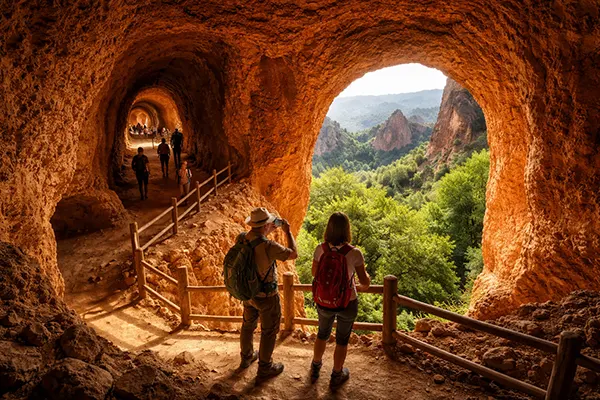
Modern visitors can explore Las Médulas through a network of marked walking routes that pass through tunnels, viewpoints and forested areas. The most popular route leads to the Mirador de Orellán, offering a panoramic view of the distinctive red formations. Access to some tunnels requires basic equipment such as a torch, as they remain unlit.
The nearby village of Las Médulas serves as the main access point, with visitor centres providing historical context, maps and guided tour options. These resources help travellers understand the scale of Roman operations and the subsequent evolution of the landscape.
The best time to visit is typically spring or autumn, when temperatures are moderate and the contrast between red rock and surrounding vegetation is most visible. Seasonal changes, particularly in chestnut forests, add another layer to the visual experience of the area.
Balancing Tourism and Preservation
As interest in Las Médulas has grown, local authorities have implemented measures to manage visitor impact. Controlled access points, designated paths and educational signage aim to minimise environmental damage while maintaining accessibility.
Tourism has become an important part of the local economy, but it is carefully regulated to avoid overuse. Small-scale accommodation, local guides and cultural activities contribute to sustainable development in the region.
Las Médulas stands as an example of how historical sites can be integrated into modern tourism without losing their authenticity. It offers insight into Roman history, environmental change and the long-term relationship between people and landscape.